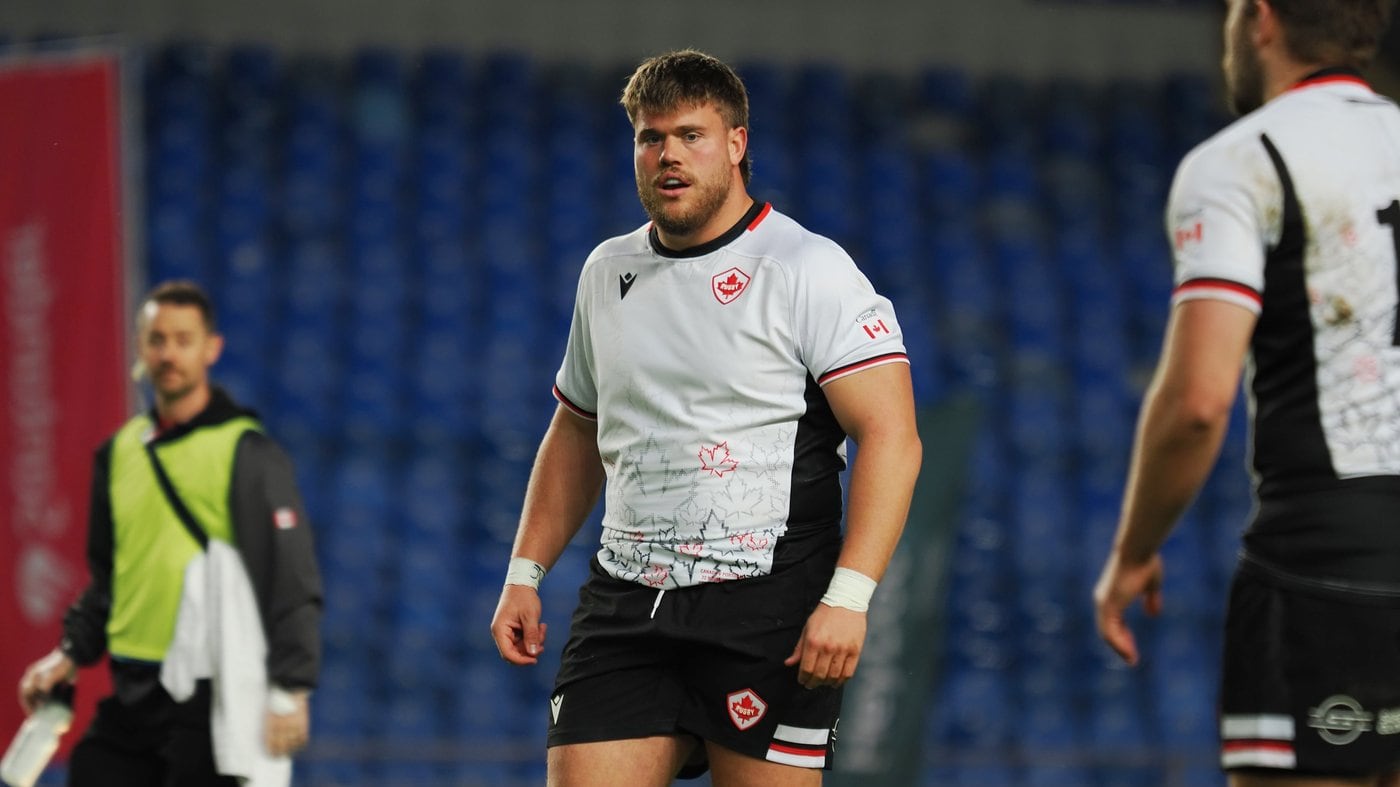
When Emerson Prior works a nursing shift at Victoria's Royal Jubilee hospital, patients comment on what a big guy he is, see his cauliflower ear and then ask if he plays rugby.
"I don't look like the standard nurse on my floor," Prior said.
The six-foot-two, 269-pound prop from Brockville, Ont., made his international debut for Canada's rugby team last year in matches against Spain, Georgia and Portugal.
Prior's pursuit of a spot on the national team continues in 2026 as Canada prepares for the Men's Rugby World Cup 2027 in Australia. Canada qualified after missing out in 2023.
Up until this year, Prior had a paying rugby gig outside the Canadian team with Major League Rugby's Utah Warriors.
The U.S.-based league changed its import rules, however, to make Canadians no longer domestic players, but internationals. The MLR also contracted by five clubs.
So about 50 Canadian men who played in that league shrunk to a dozen. Some have found other leagues, but not all.
"What that means for me and other people in my position is that it immediately takes us out of a full-time training environment," Prior said.
"When you're in the MLR, you're getting paid, first of all. You've got your housing and car sorted and then you're full-time training, Monday through Saturday evening.
"I went from a full year of rugby in 2025 to now in January, I'm working night shifts, sleeping for a couple hours and getting up and going to the gym and then going to practice.
"I still need to work probably 20 to 25 hours a week. I have other buddies that are on the tools, at the end of a shovel for eight, 10 hours a day and then they go to the gym and then they're off to training."
New England Free Jacks centre Ben LeSage is among the few Canadians who retained his MLR job.
"There are a lot of people who are playing a lot less rugby this year and are being faced with much more difficult questions about their future around rugby in particular because of this one change around Canadians and their eligibility," said the 30-year-old Calgarian.
Rugby Canada ran a $670,000 deficit in 2025 to both prepare the women's team for the World Cup — where Canada reached the final — and also qualify the men for 2027.
Of the $3.6 million Rugby Canada spent on the women's World Cup campaign, it generated $1 million of it through a fundraiser. Rugby Canada also came to an arrangement with the women whereby the athletes would take less money in training camps, in order to lengthen those camps and train together longer.
There's still a lot of financial terrain for Rugby Canada's chief executive officer to conquer in 2026.
"The money's gone. I spent it," Nathan Bombrys said. "We spent it on what we said we would and we're back to being short."
The federal government announced last month a financial boost of $660 million for 65 national sports organizations over the next five years, but that money isn't yet in the bank.
In the meantime, Rugby Canada and Picton Investments have partnered on an "Earned Not Given" fundraiser.
The goal of the campaign is to capture hearts and minds of the private and corporate sectors to bolster not only Canada's men's and women's 15s teams, but the women's and men's sevens sides in the run-up to the 2028 Olympic Games in Los Angeles.
"One of the things that the government has said in their announcement was they want to encourage national sports organizations to partner with the private sector, to partner with philanthropy, so Rugby Canada has been doing that," Bombrys said. "I don't suspect the government money is going to come solve all of our problems, but at the same time, we want to help ourselves.
"We need to raise money to put the Canadian national team on the field this year. And then it's 2027. Our men's national team wants to have a campaign to go to the World Cup and compete well. It's our job to send them there well. We need to find money that we don't have to do that."
Bombrys also foresees trying to compensate for the reduced number of pro rugby jobs for players such as Prior.
"We do provide a player support payment to our players," he said. "If we're successful in raising more money, we can provide more support to those players to enable them to commit to the program."
Picton became a corporate sponsor, but its marketing department also helped develop "Earned Not Given" to amplify Rugby Canada's fundraising campaign.
"It really places emphasis on the players earning everything that they've got and how you can help them close some of the funding gaps that exist," said Picton's chief marketing officer Leisha Roche. "The injustice really is that they're underfunded.
"There's a lot of companies out there nowadays are just looking for a sponsorship to say, 'I'm going to slap my logo on a jersey, I'm going to get a logo on billboard and I'm to pay you the money.' We want deeper activation of course for our brand, but most importantly for them."
Olivia Apps, who won women's World Cup silver last year and captained Canada to Olympic sevens silver in 2024, has a paying rugby job with London's Saracens of Premiership Women's Rugby.
She worries, however, about Canada's continued success in women's rugby. Apps says there isn't a clear development path for women after university.
"Every cent and every day that we get to spend together in camp is definitely earned and nothing is really given to us as female athletes and rugby players in Canada," Apps said.
"The women's game is becoming more and more professional. Other countries are putting more money behind their national teams with men and women, but especially women's teams are getting more money. Our Canadian team has been top three consistently, but now that everything's becoming more professional, if we don't catch up to that I think we will quickly fall under.
"I feel like a lot of people would say 'you've done more with less, why do you need more money?' It's short-sighted to not see how much of an impact sport has on our nation and our communities and how important it is to nation building."
This report by The Canadian Press was first published May 21, 2026.
Donna Spencer, The Canadian Press