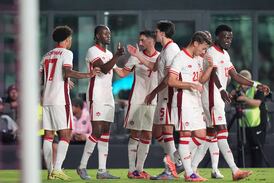
From broken bones and strained hamstrings to concussions and ruptured ligaments, Canada’s top soccer stars have weathered a swath of injuries leading up to the FIFA World Cup.
The seemingly endless ailments have forced head coach Jesse Marsch to pivot in his preparation plans and tinker with his roster ahead of the tournament.
“There’s a lot of work going on behind the scenes to try to put all our players in positions to succeed … so that we can achieve our goals of making a deep run and setting up our players to be as strong and healthy and ready as possible," he said at the team’s training camp in Charlotte, N.C., last month.
“We’re not going to make any excuses; we’re not going to complain about anything. We’re going to be all positive in making sure that everything we do is about our relentless desire to achieve our goals. And we’re not letting anything get away.”
When Canada kicks off the tournament against Bosnia-Herzegovina in Toronto on Friday, the national team will likely be without its biggest star.
Bayern Munich left back Alphonso Davies went down with a hamstring strain while playing in a Champions League semifinal in early May and has yet to resume full training with the national squad.
The strain is the latest in a string of injuries — including a torn anterior cruciate ligament — that have kept the 25-year-old defender from playing for Canada since March 2025, and Davies admitted suffering a setback on the cusp of a home World Cup wasn’t easy.
“It was tough,” he said after watching his teammates take on Uzbekistan in his hometown of Edmonton earlier this month. ”I mean, the last year was obviously up and down for me with the ACL that happened, with the little muscle injuries here and there.
“But at the end of the day, I think I just have to keep my head down and keep working. Can’t let that affect me. Obviously it was tough mentally and physically, but I’m feeling good now and hoping to recover as quickly as possible.”
Marsch has already had to make one change to his roster due to injury.
Midfielder Marcelo Flores ruptured his ACL while playing for UNAL Tigres in the CONCACAF Champions Cup final on May 30. He was officially replaced by Jayden Nelson, a 23-year-old winger from Brampton, Ont., on Tuesday.
The Canadian lineup could see another change if Moïse Bombito isn’t fit to play.
The 26-year-old centre back fractured his left tibia playing for OCG Nice in October and has been working his way back to full health ever since.
Returning to play is both a physical and mental process, Bombito said, especially for a defender.
At Canada’s training camp, the Montreal product said he was doing well and working to eliminate any lingering hesitation from his game.
“I just feel like in the state that I was, let’s say four months ago, there’s so much progress that I’m really confident in having to use that leg that was broken — not broken anymore — just use it as a tool to be successful," he said. “Now, the fact that I’m here with the national team, playing, running, that means that I’ve made a lot of progress. I’ve just got to keep building on that.”
Bombito didn’t have to look far for advice on coming back from the injury. Canadian goalkeeper Maxime Crépeau and winger Tajon Buchanan both know firsthand what the gruelling recovery from a broken leg entails.
“I asked where they were in terms of if they feel a little bit of pounding, what does that mean?” he said. “They give me a lot of feedback, also, to break that fear mentally. I think they’ve been a great tool to my readiness, for sure.”
Bombito played 31 minutes in Canada’s 2-0 win over Uzbekistan and was spotted icing his injured leg after leaving the field. He was on the bench for the country’s 1-1 draw with Ireland in Montreal on Friday, but did not come into the game.
This week, his training has been modified as the squad continues tuning up in Toronto.
Marsch said he will give Bombito until the very last minute to recover.
“Moise, we’re just going to go day by day,” the coach said on Monday. “I thought he looked really good today, so that was a positive development for him.”
Teams have until 24 hours before their first match to swap out any seriously injured or ill players.
When Ali Ahmed was hurt while playing for Norwich City in early May, he worried the hamstring strain would hamper his chances of making the Canadian team.
“I’ll be honest — it’s definitely one of the first things that comes to your mind," he said. “You hope it’s nothing serious that will hurt my chances of performing at the highest level I can over here.”
The 25-year-old winger had never experienced a hamstring injury before but knew his timeline for recovery was limited.
He headed to North Carolina for training camp anyway and showed enough progress that he was named to the 26-man roster.
“I dodged a bullet,” he said. “But in all honesty, I think this is a blessing in disguise, maybe. I think my body kind of needed a little break. I was feeling a little bit fatigued and tired.”
Coming back from an injury can be tricky for top-level athletes, who must balance their hunger to get back to playing with the risk of overexertion and reinjury.
The calculations only get more complicated in the lead-up to the World Cup, said veteran right back Alistair Johnston.
“You want to be playing not just for fitness but for form,” he said. “You don’t want to be coming into the biggest tournament of your life feeling like you’re underprepared. It’s no different than a final exam as a student or something like that. You want to be ready for the test. And obviously June 12 is going to be a massive test.”
Johnston is yet another Canadian player who had to overcome injury en route to this summer’s tournament. He had hamstring surgery last fall and didn’t get back into a game until late April.
After getting ample minutes with Celtic ahead of the World Cup break, Johnston felt confident returning to the national team, even after the long layoff.
“In a perfect world, you play the whole season, you’re feeling great, you’re fully fit, you’re in the best form of your life going into the tournament,” he said. ”But that’s not sport.”
This report by The Canadian Press was first published June 9, 2026.
Gemma Karstens-Smith, The Canadian Press